The Federal Government’s Accelerated Teacher Professionalisation Pathway (ATPP) Cohort 1 application portal is now open nationwide, providing an opportunity for eligible Nigerians who are already working as teachers but do not yet possess a recognised professional teaching qualification.
The initiative is designed to help serving non-professional teachers build on their existing academic qualifications and classroom experience while obtaining recognised professional education credentials through an accelerated training pathway.
The programme is supported by the Federal Ministry of Education, the National Teachers’ Institute (NTI) and the Teachers Registration Council of Nigeria (TRCN) as part of broader efforts to strengthen teacher professionalisation, improve teaching standards and enhance learning outcomes across Nigeria.
One of the major features of ATPP is its blended learning structure, which is designed to make professional training more accessible to serving teachers. Eligible participants can undertake academic and practical components of the programme while continuing with their teaching responsibilities, subject to the applicable programme arrangements.
Depending on an applicant’s existing academic qualification, the pathway may lead to a Postgraduate Diploma in Education (PGDE) or Professional Diploma in Education (PDE), followed by the applicable TRCN professional registration and licensing requirements.
What Is the Accelerated Teacher Professionalisation Pathway (ATPP)?
The Accelerated Teacher Professionalisation Pathway (ATPP) is a national initiative designed to provide a structured route for serving teachers who have academic qualifications but lack formal professional teacher education.
Many Nigerians currently working as teachers possess degrees, HND, ND or OND qualifications but did not originally study education.
ATPP provides eligible teachers with an opportunity to acquire professional education knowledge and practical teaching skills without necessarily having to leave their current teaching positions.
Rather than focusing solely on academic qualifications, the programme places emphasis on the professional competencies required to become an effective, ethical and responsible teacher.
Participants are expected to develop knowledge and practical skills in areas such as:
More From Skill4today
View all- Educational psychology
- Curriculum development
- Teaching methodology and pedagogy
- Classroom management
- Learner assessment
- Inclusive education
- Child safeguarding
- Digital and blended learning
- Professional ethics and conduct
- Teaching practice
The programme therefore goes beyond simply obtaining another certificate. Its broader objective is to improve the quality, competence and professionalism of teachers working in Nigerian classrooms.
Why Was ATPP Introduced?
Having a strong academic background in a particular subject does not automatically mean that an individual has received professional teacher training.
For example, someone with a Bachelor’s degree in Economics, Mathematics, Biology, English or another discipline may have strong subject knowledge but may still require professional preparation in areas such as lesson planning, classroom management, assessment, child protection and effective instructional methods.
ATPP seeks to address this gap by providing serving non-professional teachers with a structured professionalisation pathway.
The programme is intended to contribute to:
- Strengthening teacher competence
- Improving professional teaching standards
- Standardising professional teaching qualifications
- Supporting teacher registration and licensing
- Promoting professional ethics and accountability
- Improving classroom teaching practices
- Strengthening child safeguarding practices
- Supporting education quality assurance
- Building a more professionally qualified teaching workforce
- Improving learning outcomes for Nigerian learners
The programme is therefore better understood as a professional development and qualification pathway, rather than simply another short-term teacher training exercise.
Who Is the ATPP Programme For?
The programme is primarily targeted at serving non-professional teachers who are already teaching but do not have a recognised professional teaching qualification.
The stated target groups include eligible:
- Non-education Bachelor’s degree holders currently teaching
- HND holders currently working as teachers
- ND and OND holders currently teaching
- Teachers in public and non-state schools
- ECCDE teachers and practitioners
- Primary school teachers
- Secondary school teachers
- TVET instructors and teachers
- Teachers in non-formal and alternative education settings
- Community instructors and volunteer educators, where applicable
A major requirement for the accelerated pathways is at least 24 months of classroom teaching experience.
However, applicants should carefully review the official eligibility requirements for their specific pathway because possessing a particular academic qualification or teaching experience does not, by itself, guarantee admission.
SEE ALSO: Federal Government Launches N50,000 Conditional Grant Scheme (CGS) for Small Businesses via SMEDAN
ATPP PGDE and PDE Pathways Explained
One important point prospective applicants should understand is that not every applicant will follow the same ATPP pathway.
The pathway depends largely on the applicant’s existing academic qualification and the applicable programme requirements.
1. PGDE Pathway for Eligible BSc and HND Holders
The Postgraduate Diploma in Education (PGDE) pathway is designed for eligible holders of a non-education Bachelor’s degree or HND who are already working as teachers and meet the required experience criteria.
The programme information indicates a minimum of 24 months of classroom teaching experience for the accelerated pathway.
PGDE pathway at a glance:
- Qualification: Postgraduate Diploma in Education (PGDE)
- Duration: Approximately 6 months
- Credit load: 40 units
- Study format: Blended/Hybrid
- Practical component: Supervised teaching practice
- Target applicants: Eligible non-education Bachelor’s degree and HND holders
- Professional outcome: Pathway towards the applicable TRCN professional registration requirements
This pathway is particularly relevant to graduates who entered the teaching profession with a degree or HND but did not study education as their primary discipline.
2. PDE Pathway for Eligible ND and OND Holders
The Professional Diploma in Education (PDE) pathway is intended for eligible holders of ND or OND qualifications who are already teaching and satisfy the applicable experience and admission requirements.
Like the PGDE pathway, the programme combines academic learning with supervised practical teaching.
PDE pathway at a glance:
- Qualification: Professional Diploma in Education (PDE)
- Duration: Approximately 6 months
- Credit load: 37 units
- Study format: Blended/Hybrid
- Practical component: Supervised teaching practice
- Target applicants: Eligible ND/OND holders
- Professional outcome: Pathway towards TRCN registration under the applicable category
Applicants should not assume that simply possessing an ND, OND, HND or Bachelor’s degree automatically qualifies them for admission. The official programme requirements and verification process will determine eligibility.
How Long Does ATPP Take?
The accelerated programmes are designed to be completed in approximately six months.
The structure combines approximately:
- Four months of hybrid academic study
- Two months of supervised teaching practicum
This arrangement is particularly useful for serving teachers because the programme is designed around a blended model that can allow participants to continue their teaching responsibilities while undertaking their professional training.
The specific academic timetable, contact sessions, study-centre arrangements and practicum requirements may vary according to the participating institution and cohort.
How Does ATPP Blended Learning Work?
ATPP adopts a blended learning approach that combines physical contact sessions with online learning.
Participants may engage with the programme through designated study centres and the ATPP Learning Management System (LMS).
The learning process includes several components.
1. Self-Instructional Learning
Participants are provided with learning materials and are expected to undertake independent study before and between scheduled contact sessions.
This allows teachers to study at their own pace while keeping up with their existing responsibilities.
2. Facilitated Contact Sessions
Qualified facilitators and resource persons provide guidance during scheduled contact sessions at designated study centres.
These sessions give participants opportunities to interact with facilitators, ask questions, discuss educational concepts and receive clarification on challenging areas.
3. Online Learning
Participants are expected to access relevant learning materials, complete online modules, assignments and continuous assessment activities through the designated LMS.
4. Supervised Teaching Practice
Practical teaching is an important component of ATPP.
Participants are expected to demonstrate the professional knowledge acquired during the programme in real classroom environments. Their teaching practice may be supervised, assessed and credited as part of the programme requirements.
This practical component is important because effective teaching involves more than theoretical knowledge. Teachers must also demonstrate the ability to plan lessons, manage learners, deliver instruction and assess learning effectively.
What Will ATPP Participants Learn?
The programme is designed around professional competencies required by teachers in modern educational environments.
These competencies broadly cover four areas:
1. Professional Knowledge
Participants develop an understanding of learners, educational principles, subject content and factors that influence teaching and learning.
2. Professional Practice
This area focuses on practical teaching skills, including lesson planning, classroom management, instructional delivery and learner assessment.
3. Professional Values, Ethics and Conduct
Teachers are expected to demonstrate professionalism, integrity, responsibility and appropriate conduct when dealing with learners, colleagues, parents and the wider education community.
4. Professional Engagement and Continuing Development
Teaching is a profession that requires continuous learning. Participants are introduced to professional development practices that can help them adapt to changing curricula, technology, teaching methods and learner needs.
Key Areas Covered Under ATPP
The programme covers several areas relevant to professional teaching, including:
- Foundations of Education
- Educational Psychology
- Curriculum and Pedagogy
- Inclusive Education
- Child Safeguarding
- Assessment and Data Use
- Education Quality Assurance
- Digital and Blended Learning
- Subject Methodology
- Teaching Practice
- Professional Ethics and Conduct
The programme can also cater to different educational contexts, including ECCDE, primary, secondary and TVET education.
ATPP and TRCN Professional Registration
Another major reason eligible teachers may be interested in ATPP is its relationship with the Teachers Registration Council of Nigeria (TRCN) and teacher professionalisation.
The pathway is structured to enable eligible participants to acquire the relevant professional education qualification and subsequently meet the applicable requirements for professional teacher registration.
According to the programme information, candidates are expected to sit for and pass the TRCN Professional Qualifying Examination (PQE) as part of the professionalisation process.
However, applicants should understand an important distinction:
Completing the PGDE or PDE programme is not automatically the same as receiving a TRCN professional licence.
Participants must satisfy the relevant registration, examination and licensing requirements applicable to them.
What Are the Requirements for Completing the Programme?
Participants are expected to satisfy both academic and practical requirements before completing the programme.
These may include:
- Completing the required credit units
- Passing the supervised teaching practice
- Meeting institutional assessment requirements
- Completing assignments and continuous assessments
- Demonstrating appropriate professional conduct
- Satisfying other requirements established by the participating institution
- Sitting for and passing the applicable TRCN Professional Qualifying Examination where required
Prospective applicants should therefore approach the programme as a genuine professional qualification pathway rather than assuming that registration alone guarantees certification.
ATPP Participating Institutions
ATPP is being delivered through participating institutions and designated study centres.
The programme information identifies institutions including:
- National Teachers’ Institute (NTI)
- Nnamdi Azikiwe University
- University of Lagos
- University of Port Harcourt
- University of Ilorin
- Ahmadu Bello University
- University of Maiduguri
- National Open University of Nigeria (NOUN)
- MIVA Open University
- Meadow Hall College of Education
- Babcock University
Prospective applicants should confirm the current participating institutions, available study centres and admission arrangements through the official ATPP platform before proceeding with their application.
Documents Applicants May Need
Applicants should have their relevant academic and personal information available before beginning the application process.
Depending on the official requirements and the applicant’s pathway, documents and information may include:
- Academic certificates or qualification details
- Identification information
- Evidence of classroom teaching experience
- Passport photograph
- Employment or teaching information
- Other documents requested during the application
Applicants should only submit documents through the official application platform and should avoid sharing sensitive personal information with unofficial agents or websites.
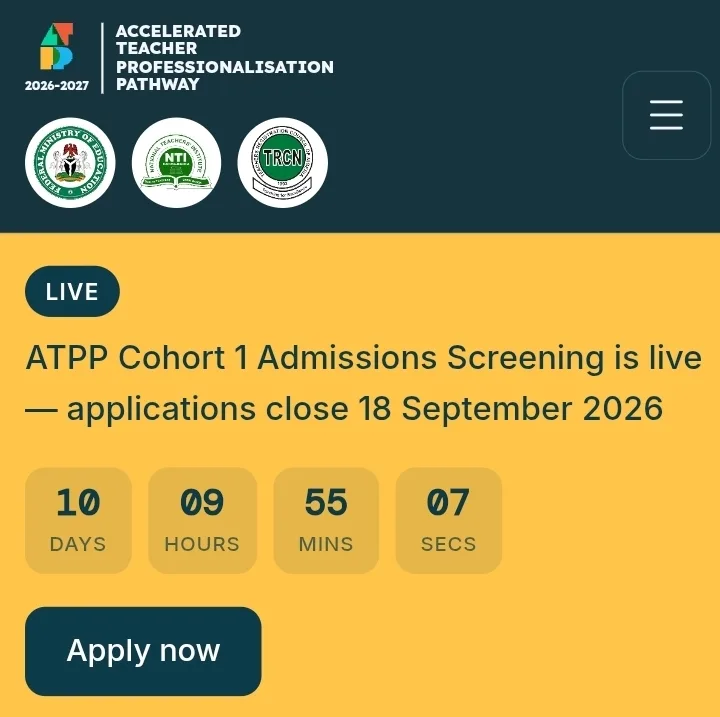
Accelerated Teacher Professionalisation Pathway (ATPP) Cohort 1 Application Deadline
18 September 2026
Prospective applicants are advised not to wait until the final day before beginning the application process. Early application can help applicants identify and resolve registration, document or technical issues before the portal closes.
How to Apply for the Federal Government ATPP Programme
Eligible teachers who wish to participate in the Accelerated Teacher Professionalisation Pathway should apply through the official government-authorised ATPP portal.
Visit the Federal Government ATPP Programme Official Portal, review the programme requirements, select the appropriate pathway, complete the application, review and submit your application online.
Important Warning to Applicants
Applicants should be cautious of individuals or websites claiming to offer guaranteed admission, certificates or TRCN licences in exchange for additional payments.
Always confirm programme information through the official ATPP platform and relevant government channels before making payments or submitting personal information.
Also note that having a BSc, HND, ND or OND alone does not automatically guarantee admission or professional licensing. Applicants must meet the specific requirements applicable to their pathway and complete the required academic, practical and professional stages.
Final Takeaway
The Federal Government’s Accelerated Teacher Professionalisation Pathway (ATPP) offers serving non-professional teachers an opportunity to obtain formal professional education qualifications while building on the classroom experience they have already acquired.
For eligible teachers with BSc, HND, ND or OND qualifications, the programme may provide a structured route towards professional teacher qualification and the applicable TRCN registration and licensing requirements.
With Cohort 1 applications closing on 18 September 2026, eligible serving teachers who are interested in the programme should review the official requirements and begin their application early.
You can also visit Dailylight Channel Graduate Jobs Section, Internship Program, Recruitment Exercises, and Job and Career Opportunity Desk Section to explore and discover opportunities you are qualified to apply for.