TETFund National Research Fund Grant 2026 Now Open Nationwide. The Tertiary Education Trust Fund (TETFund) National Research Fund (NRF) Grant 2026 is now open to eligible researchers and lecturers in Nigeria’s public tertiary institutions.
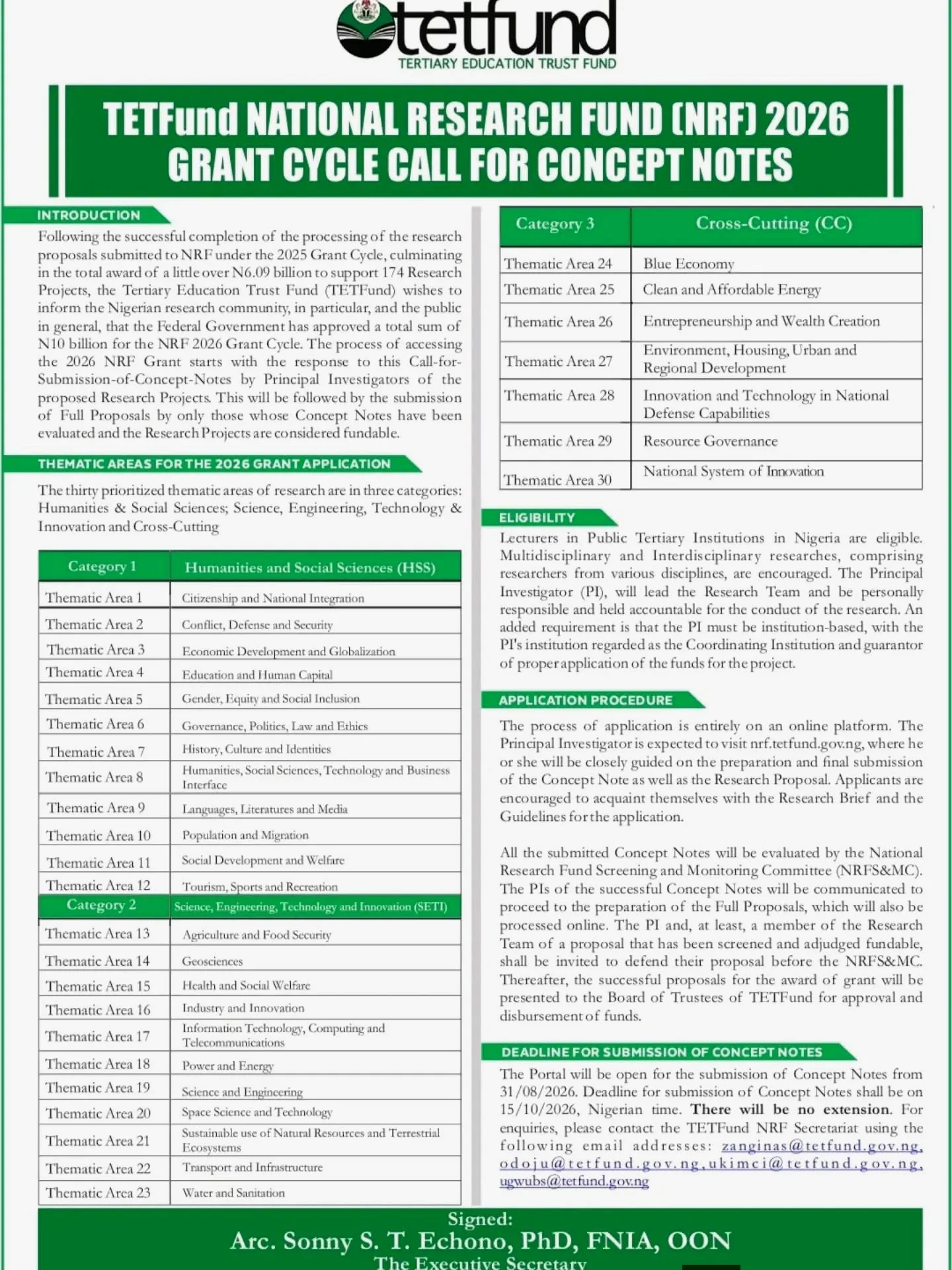
The 2026 funding cycle has a total allocation of ₦10 billion and is designed to support high-quality research projects capable of addressing critical national development challenges. The research priorities cover 30 thematic areas, spanning sectors such as agriculture, healthcare, education, technology, energy, infrastructure, governance, environment, security and economic development.
The application process starts with the submission of a Concept Note. Researchers whose Concept Notes are assessed and considered fundable will be invited to proceed to the next stage by submitting a full research proposal.
RECOMMENDED FOR YOU: Tinubu Light Initiative Empowerment Programme 2026 (Offering Solar Power and Financing Support for Nigerian Small Businesses)
What Is the TETFund National Research Fund?
The National Research Fund (NRF) is a research intervention programme established by TETFund to provide funding support for research activities in Nigeria’s public tertiary institutions.
The programme seeks to strengthen research capacity, encourage collaboration among researchers and support innovative studies that can generate practical solutions to national and developmental challenges.
For the 2026 cycle, research proposals are grouped into three broad categories:
- Science, Engineering, Technology and Innovation (SETI)
- Humanities and Social Sciences (HSS)
- Cross-Cutting Research
TETFund NRF 2026 Priority Research Areas
The 2026 NRF covers a broad range of research themes considered important to Nigeria’s development.
1. Science, Engineering, Technology and Innovation (SETI)
Researchers can submit projects relating to areas such as:
- Agriculture and Food Security
- Health and Social Welfare
- Transport
- Power and Energy
- Information Technology, Computing and Telecommunications
- Space Science and Technology
- Geosciences
- Science and Engineering
- Water and Sanitation
- Industry, Innovation and Infrastructure
- Sustainable Use of Natural Resources and Terrestrial Ecosystems
RECOMMENDED FOR YOU: Nigerian Air Force Recruitment for Tradesmen/Women and Non-Tradesmen/Women Now Open Nationwide | Apply via Nigerian Air Force Portal
2. Humanities and Social Sciences (HSS)
Eligible research areas include:
More From Skill4today
View all- National Integration, Conflict, Defence and Security
- Education and Human Capital
- Economic Development and Globalisation
- History, Culture and Identities
- Languages, Literatures and Media
- Social Development and Welfare
- Population and Migration
- Governance, Politics, Law and Ethics
- Tourism, Sports and Recreation
- Gender, Equity and Social Inclusion
- Humanities, Social Sciences, Technology and Business Interface
3. Cross-Cutting Research
The cross-cutting category includes research areas such as:
- Entrepreneurship and Wealth Creation
- Environment, Housing and Urban and Regional Development
- Resource Governance
- Science, Technology and Innovation System Management
- Blue Economy
- Clean and Affordable Energy
- Innovation and Technology in National Defence Capabilities
Who Is Eligible to Apply?
The TETFund National Research Fund is primarily targeted at lecturers and researchers affiliated with eligible Nigerian public tertiary institutions.
Eligible institutions include:
- Public universities
- Public polytechnics
- Public colleges of education
The Principal Investigator (PI) must be institution-based, and the PI’s institution will serve as the coordinating institution for the proposed research project.
TETFund also promotes multidisciplinary and interdisciplinary research. Researchers from other relevant institutions, research organisations and industry may participate in a research team where their expertise contributes meaningfully to the proposed project.
RECOMMENDED FOR YOU: National Human Resource Management for Taskforce (NHRMT) Announces 2026/2027 Graduate Replacement Recruitment Exercise
What Kind of Research Projects Are Encouraged?
The 2026 NRF is focused on research capable of contributing to the resolution of important national challenges.
Applicants should ensure that their proposed research clearly explains:
- The specific problem being investigated
- The research objectives
- The relevance of the study to Nigeria’s development
- The methodology that will be used
- The expected research outcomes
- The expertise and composition of the research team
- The potential impact and practical application of the findings
Projects involving researchers from different academic disciplines may also benefit from the NRF’s emphasis on multidisciplinary and interdisciplinary collaboration.
Application Deadline
15 October 2026
How to Apply for the TETFund NRF Grant 2026
The application process begins with the submission of a Concept Note through the official National Research Fund platform.
Step 1: Register as a Principal Investigator
Eligible researchers should create an account on the NRF application platform.
Applicants may be required to provide personal, academic and institutional information, including:
- Full name
- Date of birth
- Gender
- Academic rank
- Institution type
- Institution
- Highest qualification
- Qualification title
- Email address
- Phone number
- Password
Step 2: Prepare and Submit Your Concept Note
After completing registration, the Principal Investigator can proceed to prepare and submit the Concept Note through the NRF platform.
The Concept Note should clearly present the proposed research problem, objectives, relevance, methodology and expected contribution to national development.
RECOMMENDED FOR YOU: Federal Government Publishes Official List of Approved Loan Apps in Nigeria
Step 3: Concept Note Evaluation
Submitted Concept Notes will undergo assessment by the National Research Fund Screening and Monitoring Committee (NRFS&MC).
Only Concept Notes that are assessed and considered fundable will proceed to the next stage.
Step 4: Submit a Full Research Proposal
Principal Investigators whose Concept Notes successfully pass the initial screening will be invited to prepare and submit their full research proposals.
Selected researchers may also be required to defend their proposals as part of the subsequent evaluation process.
Official TETFund NRF 2026 Application Portal
Researchers should use the official National Research Fund platform for registration, accessing the research brief and guidelines, and submitting their Concept Notes.
Applicants are advised to rely on the official TETFund NRF platform and guidelines when preparing their applications.
TETFund NRF 2026 Application Deadline
The deadline for submission of Concept Notes for the 2026 TETFund National Research Fund Grant is 15 October 2026
According to the information provided for the 2026 funding cycle, there will be no extension of the deadline.
Eligible researchers are therefore encouraged to complete their registration and submit their Concept Notes well before the closing date to avoid last-minute technical or submission issues.
How Much Is Available Under the 2026 NRF Grant?
The 2026 TETFund National Research Fund cycle has a total funding allocation of ₦10 billion.
It is important to understand that the ₦10 billion is the overall funding pool for the 2026 cycle and does not mean that an individual researcher will automatically receive ₦10 billion.
Funding will be awarded to successful research projects based on the applicable evaluation and selection process.
Important Things Applicants Should Know
Before submitting a Concept Note, prospective applicants should:
- Confirm that they meet the eligibility requirements.
- Ensure that their institution qualifies under the NRF requirements.
- Select a research topic that falls within the approved 2026 thematic priorities.
- Carefully review the official research brief and application guidelines.
- Clearly establish the national importance of the proposed research.
- Ensure that the Concept Note is properly prepared and submitted through the official platform.
- Submit the application before the 15 October 2026 deadline.
- Keep their registration and application details secure for subsequent stages.
RECOMMENDED FOR YOU: YABATECH Massive Recruitment 2026 Now Open – Academic & Non-Teaching Positions Available at Yaba College of Technology (YABATECH)
Apply for the TETFund National Research Fund Grant 2026
The 2026 TETFund National Research Fund provides an opportunity for researchers and lecturers in Nigeria’s public tertiary institutions to seek funding for research projects focused on solving significant national challenges.
- Total Funding Allocation: ₦10 Billion
- Application Stage: Concept Note Submission
Eligible researchers should review the official guidelines carefully, develop a strong and relevant Concept Note, and complete their submission before the deadline.
You can also visit Dailylight Channel Graduate Jobs Section, Internship Program, Recruitment Exercises, and Job and Career Opportunity Desk Section to explore and discover opportunities you are qualified to apply for.